
Milestone 2 - Conservation and balance
Conservation laws
Many processes in nature and engineering can be modeled (described) with a simple principle: the principle of conservation. Consider a closed domain and a quantity that is defined for all and . The function typically describes a physical quantity such as mass, momentum, or energy.
We are interested in modeling the temporal evolution of (change in time ). Observations of nature of the behaviour of such quantities lead to the following simple principle:
The quantity of changes, if:
(i) There is a positive/negative source inside of the sub-domain
(ii) There is a positive/negative flux balance through the boundary of the sub-domain
Famous example: Bathtub 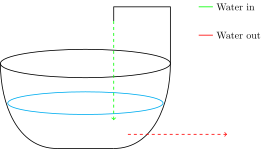
The amount of water in the bathtub (blue) changes due to the sources (green) and sinks (red).
Formulation of the mathematical problem
Consider a sub-domain with outward pointing normal vector :
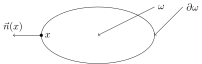
If we make the mathematical assumption that the function is sufficiently smooth (such that we can take the derivatives in space and time), we can apply the Gauss integral theorem to the surface integral
As we have chosen an arbitrary sub-domain with no special properties, the equation needs to hold for all choices of . This can only be true if the integrands balance out to zero, hence
Remark 4: For many processes, the source term can be neglected, i.e., we can choose . The resulting PDE describes processes, where the quantity is neither destroyed nor generated, but is only changed by fluxes. Such PDEs are called conservation laws
Depending on the process we want to model, we need to chose the quantity of interest , a model for the flux and a model for the source term . There are many examples of such models, e.g., mass and momentum conservation in fluid mechanics. We consider here as an example the so-called heat equation, or heat transfer equation.
For the heat equation we are interested in the change of temperature (which is strongly related to the internal energy of a body) in space and time, hence our choice for the unknown quantity is . Next, we need a model for the flux. Jean Babtiste Joseph Fourier (1822) gave a model for the heat flux, where the flux of heat is negative proportional to the temperature difference (heat goes from high temperatures to lower temperatures), i.e.
where is the heat conduction coefficient with in general.
Remark 5: A very simple version of the heat equation results in 1D space () with a constant diffusion coefficient
For scalar PDEs with two independent variables and of second order (the maximum derivatives are second-order derivatives) it is common to distinguish between different types of PDEs. Assuming a scalar second order PDE of the general form
we can define the quantity
to get a classification of the different types
(i) , the PDE is elliptic in
(ii) , the PDE is parabolic in
(iii) , the PDE is hyperbolic in
These definitions are motivated by the definition of conic sections. It is interesting to note, that the type of the PDE has strong implications about the solution behaviour. Hence, there are typical processes that are in nature either elliptic (e.g. gravity), hyperbolic (wave equations, advection), or parabolic (heat equation):
If we consider again our simple 1D constant coefficient heat equation and compute its type, we get . Hence, the heat equation is a parabolic PDE.
In general, parabolic PDEs model processes that evolve in time and are not reversible in time, such as friction, diffusion, dissipation, etc. The effect over time is a "smearing" of the quantity, smoothing out of large gradients and extrema.
Created by Gregor Gassner and Andrés Rueda-Ramírez with contributions by Simone Chiocchetti, Daniel Bach, Sophia Horak, Philipp Baasch, Benjamin Bolm, Erik Faulhaber, and Luca Sommer. Last modified: April 02, 2026. Website built with Franklin.jl and the Julia programming language.